

As a supplier of Water To Water Heat Pump, I've spent years delving into the intricacies of these remarkable systems. One question that often arises is about the performance of water to water heat pumps at different altitudes. In this blog, I'll explore this topic in detail, drawing on scientific knowledge and real - world experience.
Basic Principles of Water to Water Heat Pumps
Before we discuss the impact of altitude, let's briefly understand how water to water heat pumps work. These systems transfer heat from one water source to another. They operate on the principles of thermodynamics, using a refrigerant cycle to absorb heat from a low - temperature water source and release it at a higher temperature to another water source. This process can be used for both heating and cooling applications.
The main components of a water to water heat pump include an evaporator, a compressor, a condenser, and an expansion valve. The refrigerant absorbs heat in the evaporator, is compressed by the compressor to increase its temperature, releases heat in the condenser, and then expands through the expansion valve to start the cycle again.
Impact of Altitude on Atmospheric Pressure
Altitude has a significant impact on atmospheric pressure. As altitude increases, atmospheric pressure decreases. This is because the weight of the air above a given point decreases with increasing height. The relationship between altitude and atmospheric pressure can be described by the barometric formula.
At sea level, the standard atmospheric pressure is approximately 101.3 kPa. For every 1000 meters increase in altitude, the atmospheric pressure drops by about 10 - 12 kPa. This decrease in pressure affects the performance of water to water heat pumps in several ways.
Effect on Refrigerant Properties
The properties of the refrigerant used in water to water heat pumps are highly dependent on pressure. At lower atmospheric pressures (higher altitudes), the boiling point of the refrigerant decreases. This means that the refrigerant will boil at a lower temperature in the evaporator.
A lower boiling point can lead to a decrease in the heat transfer rate in the evaporator. Since the temperature difference between the refrigerant and the low - temperature water source is reduced, the amount of heat that can be absorbed by the refrigerant per unit time is also reduced. This, in turn, affects the overall heating or cooling capacity of the heat pump.
Moreover, the compressor in the heat pump is designed to operate within a certain pressure range. At higher altitudes, the lower suction pressure can cause the compressor to work less efficiently. The compressor may have to work harder to achieve the same compression ratio, leading to increased energy consumption and potentially reduced lifespan.
Impact on Fan and Pump Performance
In addition to the refrigerant system, altitude also affects the performance of the fans and pumps in a water to water heat pump. Fans are used to move air (in some cases) or to enhance heat transfer in the condenser, while pumps are used to circulate water through the system.
The performance of fans is closely related to air density. As altitude increases, air density decreases. A fan that is designed to operate at sea level may not be able to move the same volume of air at a higher altitude. This can result in reduced heat transfer in the condenser, as less air is available to carry away the heat released by the refrigerant.
Pumps, on the other hand, are affected by the pressure difference they need to overcome. At higher altitudes, the lower atmospheric pressure can change the net positive suction head (NPSH) requirements of the pump. If the NPSH is not properly maintained, the pump may experience cavitation, which can damage the pump impeller and reduce its efficiency.
Performance at Different Altitude Ranges
Let's break down the performance of water to water heat pumps at different altitude ranges:
Low Altitudes (0 - 500 meters)
At low altitudes, the impact of altitude on the performance of water to water heat pumps is relatively minor. The atmospheric pressure is close to the standard sea - level pressure, and the changes in refrigerant properties, fan performance, and pump performance are negligible. The heat pump can operate as designed, achieving its rated heating and cooling capacities with normal energy consumption.
Medium Altitudes (500 - 2000 meters)
As the altitude increases from 500 to 2000 meters, the decrease in atmospheric pressure starts to have a noticeable effect. The heat pump may experience a slight reduction in heating and cooling capacity. The compressor may consume more energy due to the lower suction pressure. The fans may not be as effective in moving air, and the pumps may require some adjustments to maintain proper NPSH.
High Altitudes (above 2000 meters)
At high altitudes, the performance of water to water heat pumps can be significantly affected. The decrease in refrigerant boiling point and the lower suction pressure can lead to a substantial reduction in heating and cooling capacity. The compressor may struggle to operate efficiently, and the fans and pumps may need to be oversized or specially designed to compensate for the low air density and pressure changes.

Solutions for High - Altitude Applications
To ensure the optimal performance of water to water heat pumps at high altitudes, several solutions can be implemented.
Refrigerant Selection
Choosing a refrigerant with suitable properties for high - altitude operation is crucial. Some refrigerants are more tolerant of low pressures and can maintain better performance at higher altitudes. Manufacturers may need to adjust the refrigerant charge and the operating parameters of the heat pump based on the altitude.
Compressor Design
Compressors can be designed to operate more efficiently at lower suction pressures. Variable - speed compressors can adjust their speed according to the operating conditions, allowing them to maintain a stable compression ratio and improve energy efficiency at high altitudes.
Fan and Pump Optimization
Fans and pumps can be optimized for high - altitude applications. High - altitude fans can be designed with larger blades or higher rotational speeds to compensate for the low air density. Pumps can be selected with appropriate NPSH requirements and can be equipped with pressure - boosting devices if necessary.
Our High Temperature Water Source Heat Pump for Different Altitudes
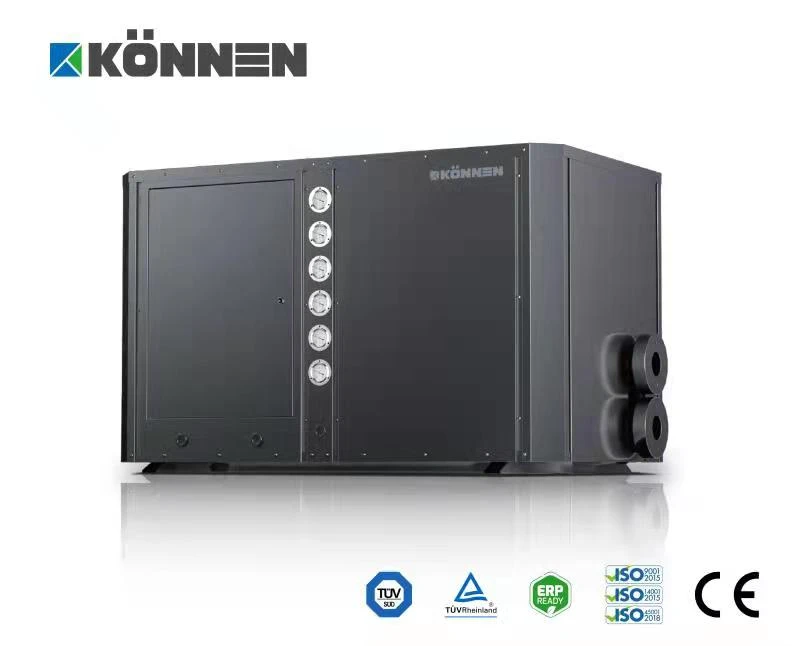
We offer a range of Water To Water Heat Pump products, including High Temperature Water Source Heat Pump, which are designed to perform well at different altitudes. Our engineering team has extensive experience in adapting heat pump systems to various environmental conditions.
We conduct thorough testing on our products at different altitudes to ensure that they meet the performance requirements. Whether you are in a low - altitude area or a high - altitude mountain region, our heat pumps can provide reliable heating and cooling solutions.
Conclusion
The performance of water to water heat pumps is significantly affected by altitude. The decrease in atmospheric pressure at higher altitudes impacts refrigerant properties, fan and pump performance, and overall system efficiency. However, with proper design, refrigerant selection, and component optimization, water to water heat pumps can be made to operate effectively at different altitudes.
If you are considering purchasing a water to water heat pump for your project, regardless of the altitude, we are here to help. Our team of experts can provide you with detailed information and customized solutions to meet your specific needs. Contact us today to start a discussion about your heat pump requirements and let's work together to find the best solution for you.
References
- ASHRAE Handbook of Fundamentals. American Society of Heating, Refrigerating and Air - Conditioning Engineers.
- Thermodynamics textbooks, such as "Thermodynamics: An Engineering Approach" by Yunus A. Cengel and Michael A. Boles.
- Manufacturer's technical documentation on water to water heat pumps.